


Mrs Akpan owns six flats in Ikorodu. For three years, her tenant in Flat 4 paid on time every time. Then, last March, the payment date came and went. One week. Two weeks. A month.
Her first instinct was to call him and "talk sense into him." Her brother-in-law suggested she simply lock the gate. A neighbour said to remove the roof sheets, and "he will pack by himself."
She did none of those things. Instead, she sent a short, polite reminder. When that didn't work, she wrote a formal demand letter with a clear deadline. The tenant called her that evening. He had lost a contract, he said, and was embarrassed. They agreed to a three-part payment plan, put it in writing, and he cleared the balance in seven weeks. He still lives in Flat 4. (Mrs. Akpan's story is an illustrative scenario drawn from common landlord experiences.)
That is the outcome most landlords want: the money, without the war. This guide shows you how to get there, step by step, and what to do lawfully if the friendly route fails.
Quick answer: What should a landlord do when a tenant owes rent in Nigeria? Start with a friendly reminder within a few days of the due date. If rent stays unpaid, have a conversation and offer a written payment plan. Next, send a formal demand letter with a deadline. If that fails, serve a valid notice to quit, then a 7-day notice of owner's intention to recover possession, and finally apply to court. Never lock out, harass or forcibly evict the tenant.
Why tenants fall behind, and why your first move matters.

Most tenants who owe rent are not villains. In today's Nigeria, many are squeezed. Food and transport costs have climbed sharply, salaries arrive late, small businesses lose contracts, and a single hospital bill can wipe out a month's budget. Some tenants simply forget, especially those who pay monthly or quarterly.
A small group will try to exploit a soft landlord. But you rarely know which kind of tenant you have on day three of a late payment. That is why your first response should be calm, documented, and firm, not angry.
How you respond in the first two weeks usually decides the outcome:
A good tenant, handled badly, becomes defensive, stops answering calls, and starts looking for another house, often without paying what they owe.
A good tenant, handled well, pays, apologizes, and renews.
A bad tenant, handled well, leaves you with a paper trail, deadlines, and the law on your side, and usually pays or leaves.
In other words, the polite, structured approach is not weakness. It is the fastest route to your money and the strongest position if you ever end up in court.
The rent arrears escalation ladder at a glance
Think of unpaid rent as a ladder with six rungs. You climb one rung at a time, and you only move up when the tenant has not responded to the rung below. The first three rungs are relationship tools. The last three are legal steps.
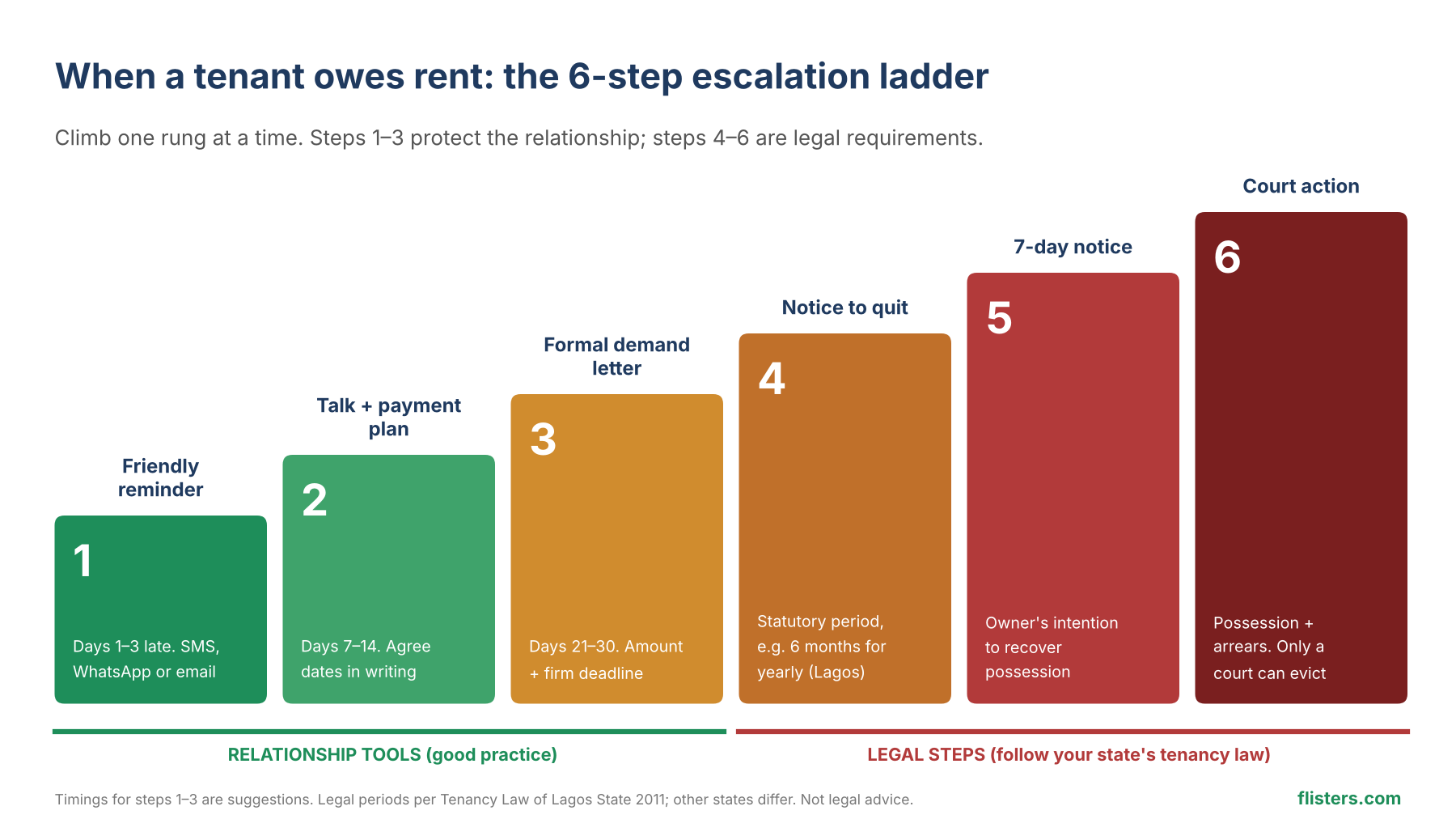
Step | When (suggested) | Tone | What you send | Legal requirement? |
|---|---|---|---|---|
1. Friendly reminder | 1 to 3 days after due date | Warm | SMS, WhatsApp, or email | No, good practice |
2. Personal conversation and payment plan | 7 to 14 days late | Understanding but clear | Call or visit, then a written plan | No, good practice |
3. Formal demand letter | About 21 to 30 days late, or a missed plan instalment | Firm, professional | Signed letter with amount and deadline | No, but strong evidence |
4. Notice to quit | After the demand deadline passes | Formal | Statutory notice, ideally drafted by a lawyer | Yes, unless an exception applies |
5. 7-day notice of owner's intention to recover possession | After the notice to quit expires | Formal | Statutory notice | Yes |
6. Court action | After the 7 days expire | Legal | Claim for possession and arrears | Yes, only a court can evict |
The suggested timings in steps 1 to 3 are good practice, not law. Adjust them to your tenancy: a monthly tenant who is 10 days late is a different case from a yearly tenant who owes the renewal. Steps 4 to 6 are set by your state's tenancy law, and the details matter.
Step-by-step: what to do when a tenant owes rent
Step 1: Send a friendly reminder (days 1 to 3)
Assume the best. Many late payments are due to forgetfulness or a salary that hasn't landed. Your reminder should be short, warm, and specific: the amount, the period it covers, and how to pay.
Sample reminder:
Good morning Mr. Okafor, I hope you and the family are well. A gentle reminder that the October rent of ₦150,000 for Flat 4 was due on the 1st. You can pay to [account details]. Please send me a message once it's done. Thank you!
Keep a copy. Screenshots of WhatsApp messages and emails are useful records later. If you want to stop chasing manually at this stage, our guide on how to collect rent without chasing tenants covers reminder schedules that prevent most late payments in the first place.
Step 2: Have a real conversation and offer a payment plan (days 7 to 14).
If the reminder receives no payment, pick up the phone or visit politely at a reasonable hour. Your goal is to find out why and when. Listen more than you talk.
If the tenant has a genuine setback, a payment plan often recovers more money, faster, than any legal process. A good plan:
Breaks the arrears into specific amounts on specific dates
Keeps current rent due as normal alongside the arrears
Is written down and signed or acknowledged by both of you (a WhatsApp "I agree" is better than nothing)
States clearly what happens if an instalment is missed
A tenant who agrees to a plan and keeps it is worth keeping. Finding a replacement tenant can mean months of vacancy, agency fees, and repairs.
Step 3: Send a formal demand letter (around days 21 to 30)
If there is no payment and no plan, or the tenant breaks the plan, it is time to change tone. A demand letter shows the tenant you are serious and creates a clear record that you requested payment before taking further steps.
Your demand letter should include:
Your name and the tenant's name, plus the property address
The exact amount owed and the rent periods it covers
A firm deadline, typically 7 to 14 days
How to pay
A clear, calm statement that you will take steps under the tenancy agreement and the law if payment is not made
Sample wording:
Dear Mr. Okafor, our records show outstanding rent of ₦300,000 for Flat 4, covering September and October 2026. Despite earlier reminders, this remains unpaid. Kindly pay the full amount on or before 30 October 2026. If you are facing difficulty, please contact me before that date so we can discuss a written arrangement. If payment is not received and no arrangement is agreed, I will take the steps available to me under our tenancy agreement and the applicable tenancy law.
Deliver it in a way you can prove: by hand with an acknowledgement copy, by courier, or by email in addition to a hard copy. Keep everything.
Step 4: Serve a valid notice to quit.
If the demand deadline passes with no payment, you move from collecting to recovering possession. In most cases, the first legal step is a notice to quit, which ends the tenancy.
In Lagos, the Tenancy Law says that a notice period written in your tenancy agreement binds both parties. Where the agreement is silent, the law sets these minimum periods, as LawPàdí summarizes:
Type of tenancy | Minimum notice to quit (Lagos, if the agreement is silent) |
|---|---|
Tenancy at will | 1 week |
Monthly | 1 month |
Quarterly | 3 months |
Half-yearly | 3 months |
Yearly | 6 months |
Two important exceptions under the Lagos law:
Fixed-term tenancy that has expired: no notice to quit is needed. You move straight to Step 5.
Serious arrears: under Section 13, where a monthly tenant owes six months' rent, or a quarterly or half-yearly tenant owes a year's rent, the tenancy lapses and you can go straight to Step 5. This shortcut does not apply to yearly tenants.
Note that the Lagos Tenancy Law does not cover Apapa, Ikeja GRA, Ikoyi, and Victoria Island, which fall under older Lagos laws governing the recovery of premises. Outside Lagos, each state has its own rules. In Abuja, for instance, the timing and calculation of notices differ from Lagos. A notice with the wrong period or wording can be invalid, which means starting again. This is the step where a property lawyer pays for themselves.
Step 5: Serve the 7-day notice of the owner's intention to recover possession.
Once the notice to quit expires and the tenant is still in the property, you serve a written 7-day notice of the owner's intention to apply to court to recover possession. In Lagos, this notice has a prescribed form (Form TL4 in the Schedule to the Tenancy Law). It must give the tenant at least seven days.
This notice is not an eviction order. It simply tells the tenant that you will go to court if they don't hand over possession.
Step 6: Go to court for possession and arrears.
If the tenant still refuses to leave, file a claim to recover possession. In Lagos, this can be brought to the Magistrate Court or High Court in the area where the property is located. You can seek possession of the property and the arrears of rent and mesne profits (compensation for the period the tenant remained after the tenancy ended), as Mondaq's overview on recovery of premises in Nigeria explains.
Bring your evidence: the tenancy agreement, rent receipts, reminders, the demand letter, the notices, and proof of service. Even after judgment, the eviction itself is carried out by court officials, not by you.
What not to do: self-help can turn you into the offender
Every Nigerian landlord has heard the stories: the gate was padlocked overnight, the roof was removed, the light was disconnected, and area boys were sent to "help" the tenant pack. These tactics are not only bad for your reputation. They can be illegal.
Under the Lagos Tenancy Law, it is a criminal offence for a landlord to forcibly eject a tenant, threaten or harass them into leaving, or demolish or alter the building to force them out. Only a court can evict a tenant in Lagos, no matter how much rent is owed. Courts in other states have also awarded damages against landlords who used force.
Avoid these common mistakes:
Locking the tenant out or changing the locks before a court order is enforced
Cutting off water or electricity to pressure the tenant
Seizing the tenant's belongings on your own. Distress for rent is a legal process with rules, not a licence to remove the tenant's TV.
Threats, insults, or public shaming, including posting the tenant on estate WhatsApp groups
Serving a notice to quit with the wrong period or before trying to resolve things, then having to start again
Refusing part payment without thinking. Accepting money can sometimes affect a notice already served, so speak to your lawyer before accepting payment after a notice to quit.
Having no paper trail. Verbal reminders leave you with nothing to show a magistrate.
A note on change ahead: the proposed Lagos State Tenancy and Recovery of Premises Bill 2025, which would extend tenancy rules statewide and raise penalties for unlawful eviction, had passed second reading but was still under committee review in mid-2026. Check its status with your lawyer before acting.
How to keep the relationship intact while you escalate

Firmness and respect are not opposites. The landlords who recover arrears fastest usually combine both. A few habits make the difference:
Separate the person from the problem. "The October rent is outstanding" lands better than "You are owing me."
Put everything in writing, kindly. Written records protect both of you and reduce "he said, she said" arguments.
Be predictable. If your reminder always goes out three days after the due date and your demand letter always follows a missed deadline, tenants learn that you mean what you say.
Acknowledge every payment. Issue a receipt for every naira, including part-payments. In Lagos, the Tenancy Law requires landlords to issue rent receipts.
Give a real option before every escalation. Each message should leave a door open: "If you are facing difficulty, contact me before this date."
Keep your temper off WhatsApp. A voice note sent in anger can become evidence against you.
The aim is that, whatever happens, the tenant can never say you were unreasonable, and a court can see that you followed every step.
How Flisters helps you handle rent arrears without the stress
Most of the steps above depend on two things: consistent communication and good records. That is exactly where landlords juggling several properties, a day job and family life fall behind.
Flisters is a property management platform built for Nigerian landlords and property managers. It takes the repetitive work off your plate:
Automatic rent reminders by email before rent is due (7, 3 and 1 days ahead), with AI-written messages in English or Pidgin and urgency that adjusts to each tenant's payment history. SMS and WhatsApp reminders are planned.
Online rent collection by card or bank transfer, with instant payment confirmation and support for partial payments, which makes payment plans easier to track.
Automatic digital receipts for every payment, so your paper trail builds itself.
A tenant portal where tenants see their rent status and payment history and can message you directly.
Financial reports showing who has paid, who owes and how much, exportable to PDF or Excel.
When you need to send a demand letter or brief a lawyer, the payment history is already organised. That saves time and strengthens your case.
Get started with Flisters free and see how much easier rent collection feels when the system does the chasing.
Frequently asked questions
Can a landlord evict a tenant for not paying rent in Nigeria?
Yes, but only through the court. Non-payment of rent is a valid ground to recover possession. The landlord must serve the correct notices, usually a notice to quit and then a 7-day notice of intention to recover possession, and obtain a court order. Self-help eviction is unlawful in Lagos.
How many months of unpaid rent before eviction in Lagos?
There is no fixed number for starting the process; you can act once rent is unpaid and notices are served. However, the Lagos Tenancy Law lets landlords skip the notice to quit where a monthly tenant owes six months' rent, or a quarterly or half-yearly tenant owes a year's rent.
What should a demand letter for unpaid rent include?
A demand letter should state the landlord's and tenant's names, the property address, the exact amount owed, the rent periods covered, a clear payment deadline, how to pay, and what steps will follow if payment is not made. Keep proof that the tenant received it.
How long is a notice to quit for a yearly tenant in Lagos?
Where the tenancy agreement does not state a notice period, a yearly tenant in Lagos is entitled to six months' notice to quit. A monthly tenant gets one month, and quarterly or half-yearly tenants get three months.
Can I lock my tenant out for owing rent?
No. Locking out a tenant, cutting utilities, removing the roof or harassing a tenant to force them out is unlawful in Lagos and can expose you to criminal charges and damages. Follow the notice and court process instead.
Should I accept a partial payment from a tenant who owes rent?
Before serving any notice, part payment under a written payment plan is often the smartest way to recover arrears. After a notice to quit has been served, speak to your lawyer first, as accepting rent can sometimes affect the notice's validity.
Is monthly rent riskier for landlords?
Monthly rent means more payment dates, so more chances for a late payment, but each missed amount is smaller and easier to recover. Our comparison of annual vs monthly rent in Nigeria examines the cash-flow trade-offs in detail.
Conclusion: firm, fair and on paper
When a tenant owes rent, your goal is not to win an argument. It is to get paid, to protect your property, and to stay on the right side of the law. Start warm, document everything, escalate one step at a time, and let the legal process do the heavy lifting only when the friendly steps fail.
Most arrears are solved at Step 1 or Step 2. The landlords who rarely reach Step 6 are the ones with clear reminders, clean records and a reputation for being both fair and firm.
Ready to stop chasing rent? Create your free Flisters account and let automated reminders, online payments and digital receipts handle the routine, so you can focus on growing your portfolio.
Disclaimer: This article is general information for Nigerian landlords, not legal advice. Tenancy laws differ by state, and the Lagos Tenancy Law does not apply in every part of Lagos. Speak to a qualified property lawyer before serving any statutory notice.


