


Four months later, his case was thrown out of court. The notice was too short for a yearly tenant, so, by law, it was never a valid notice at all. He had to start from scratch, while the flat remained occupied and unpaid.
(Alhaji Ganiyu is an illustrative landlord, but his mistake is one Lagos property lawyers see all the time.)
The lesson is simple. In Nigeria, a quit notice is only as good as its length, its timing and its service. Get any of the three wrong, and the notice is void. This guide explains the notice period for every type of tenancy, using the Lagos State Tenancy Law 2011 as the main example, with notes on Abuja and other states.
Quick answer: how long is a quit notice in Nigeria? Unless your tenancy agreement says otherwise, the Lagos Tenancy Law 2011 sets these minimum notice periods: 1 week for a tenant at will, 1 month for a monthly tenant, 3 months for a quarterly or half-yearly tenant, and 6 months for a yearly tenant. A fixed-term tenancy needs no quit notice when it expires. After the notice runs out, the landlord must serve a 7-day notice of owner's intention to recover possession before going to court.
What is a quit notice, and why does the tenancy type decide its length?
A quit notice (also called a notice to quit) is a written notice from a landlord or the landlord's authorized agent or lawyer informing a tenant that the tenancy will end on a specified date. It is the first formal step in lawfully recovering a property. It is not an eviction. Only a court order can remove a tenant in Nigeria.
The length of the notice depends on how the tenancy is structured, not on how much rent is owed or how badly the tenant has behaved. Nigerian courts classify tenancies into a few types, each with its own notice period.
Tenancy at will: no fixed period. The tenant stays as long as both sides allow, often a relative or caretaker paying little or nothing.
Periodic tenancy: it renews automatically every period until someone ends it. This covers monthly, quarterly, half-yearly and yearly tenancies, and it is the most common setup in Nigerian residential lettings.
Fixed-term tenancy: it runs for an agreed term, such as "two years from 1 January 2026", and ends by itself on the last day.
The Lagos State Tenancy Law 2011 recognises all of these: tenancy at will, monthly, quarterly, half-yearly, yearly and fixed tenancies. How you collect rent is strong evidence of the type. A tenant who has paid ₦250,000 every month since 2024 is very likely a monthly tenant, regardless of what the old agreement says.
That is why your first job, before drafting anything, is to answer one question honestly: what kind of tenancy do I actually have? If you're unsure, pull out the tenancy agreement and rent receipts. Lagos landlords are already required by law to issue a receipt for every payment, and those receipts often settle the question.
Quit notice periods under the Lagos Tenancy Law 2011
Section 13 of the Lagos State Tenancy Law 2011 sets the default notice periods. They apply only when your tenancy agreement does not set its own notice period. If the agreement does, both parties are bound by it, as LawPadi's Lagos eviction guide explains.
Tenancy type | Minimum quit notice (Lagos) | Then |
|---|---|---|
Tenancy at will | 1 week | 7-day notice of owner's intention |
Monthly tenancy | 1 month | 7-day notice of owner's intention |
Quarterly tenancy | 3 months | 7-day notice of owner's intention |
Half-yearly tenancy | 3 months | 7-day notice of owner's intention |
Yearly tenancy | 6 months | 7-day notice of owner's intention |
Fixed term (expired) | None needed | 7-day notice of owner's intention |
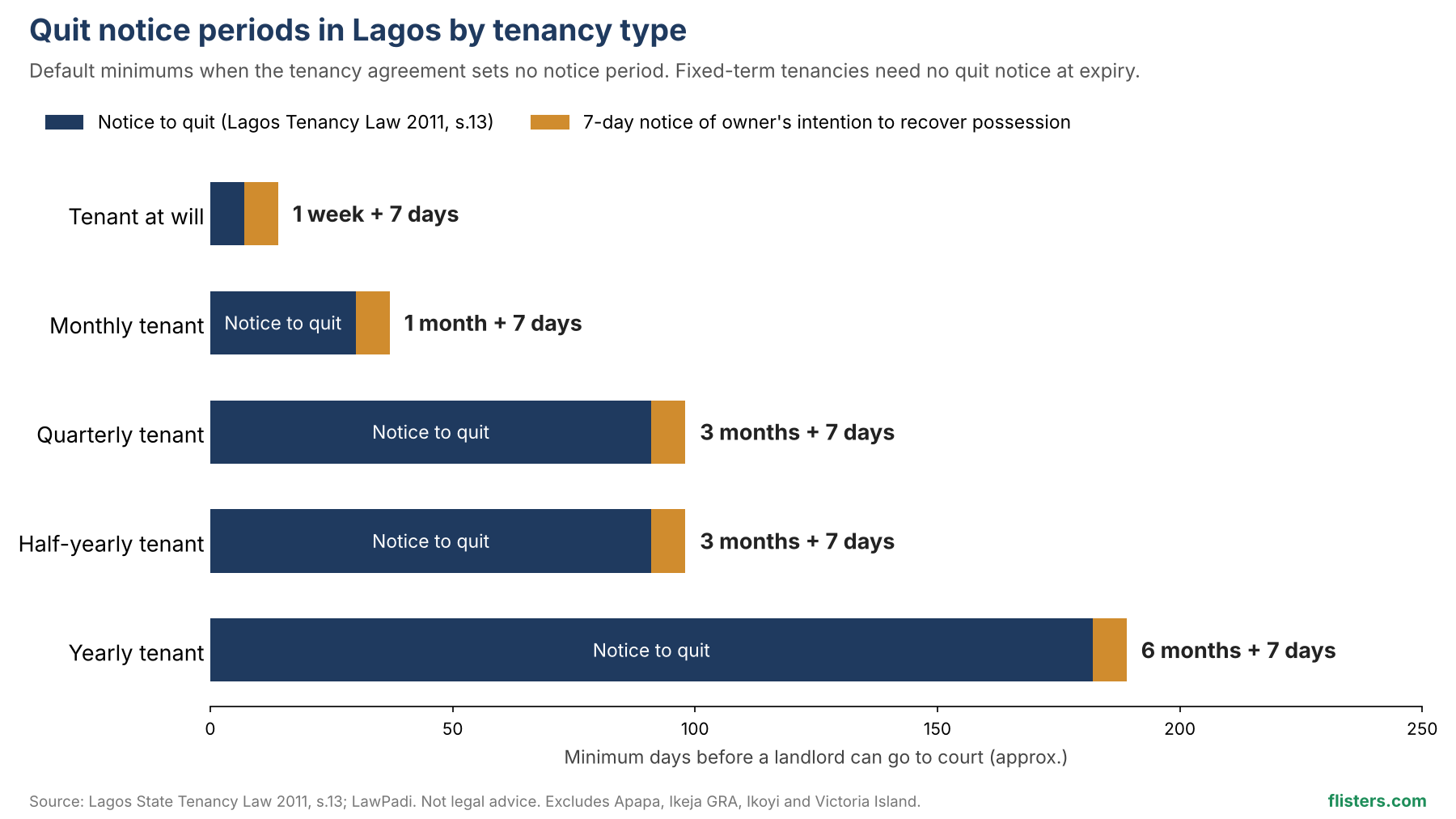
Two things stand out. First, a half-yearly tenant gets the same 3 months as a quarterly tenant, not 6. Landlords often get this wrong in both directions. Second, the yearly tenant is the big one. Most Lagos residential lets are yearly, so most landlords need to plan 6 months in advance before they can even start the court process.
The Trusted Advisors legal digest in BusinessDay confirms the same structure and notes that serving the correct notice is a condition the landlord must satisfy before a court will hear the case.
Can a tenancy agreement shorten the notice period?
Yes, within limits. Section 13 respects what the parties agreed. A clear clause such as "either party may end this tenancy by giving three months' written notice" will usually govern a yearly tenancy instead of the default six months. But courts read such clauses strictly, and any term that contradicts the Tenancy Law itself is void to that extent. If you want a shorter notice period, put it in writing at the start, not in a WhatsApp message after a dispute begins.
When you don't need a quit notice at all
There are two situations in Lagos where a landlord can skip the quit notice and proceed directly to the 7-day notice of the owner's intention.
1. The fixed term has ended.
If the tenancy was for a fixed term, say "one year from 1 February 2026 to 31 January 2027," it ends by itself on the last day. No quit notice is needed. If the tenant stays on and you don't want to renew, serve the 7-day notice and then go to court.
Be careful here. If you accept rent for a new period after the term ends, you may have created a new periodic tenancy. That new tenancy would need a full quit notice to end it. Accepting "just this month's rent" from a holdover tenant is one of the quietest ways landlords reset their own clock.

2. The tenant is deep in arrears.
Section 13 also contains a shortcut for serious arrears. Under the 2011 Law, the tenancy lapses automatically when:
A monthly tenant owes six months' rent, or
A quarterly or half-yearly tenant owes one year's rent.
In those cases, the landlord can move straight to the 7-day notice, and the court can order possession and the arrears once they are proved. This shortcut does not apply to yearly tenants. A yearly tenant who owes rent still needs the full 6-month notice, unless the fixed term has ended.
Proving arrears depends on records. A landlord who can show every receipt issued, every reminder sent, and every missed due date will have an easier time than one who relies on memory. That's one reason we recommend a clear process for when a tenant owes rent long before you reach this stage.
How to time and count your quit notice
Length is only half the rule. When the notice ends matters just as much, and this is where most notices fail.
Under the traditional common-law rule that Nigerian courts still apply to periodic tenancies, a notice to quit should expire at the end of a current tenancy period, not in the middle of one. A yearly tenancy running from 1 March to 28 February should end on 28 February, not on an arbitrary date in October.
Lagos's and Abuja differ in practice on the details. Street Lawyer Naija's comparison of tenancy practices explains that Lagos counts "clear months" starting from the first day of a new month after service. In Abuja, the notice is valid only if it ends on the eve of the tenancy anniversary. The safest approach in both places is the same: give at least the full period, and make it end on the last day of a tenancy period.
Three counting rules keep you safe:
Count from service, not from the date you typed the letter. A notice dated 1 March but served on 9 March starts running from 9 March.
Use full calendar periods. A month means a full month, not 30 days split across two months.
When in doubt, add time. A notice that is a few days too long is valid. One that is a day too short is void.
Worked example: a yearly tenant in Surulere
Mrs Okafor's tenant pays ₦3.5 million a year, with the tenancy running from 1 March to 28 February. There is no notice clause in the agreement. She decides in mid-October 2026 that she wants the flat back.
If she serves the notice on… | Earliest safe end date | Why |
|---|---|---|
31 August 2026 or earlier | 28 February 2027 | 6 full months before the end of the current year |
16 October 2026 (today) | 28 February 2028 | Less than 6 months remain before Feb 2027, so the next term end is the safe date |
That second row is painful. Missing the window by six weeks can cost a landlord an extra full year. That's why the smartest landlords track tenancy end dates months in advance, not when a problem appears. (Mrs. Okafor is an illustrative example.)
Some Lagos lawyers argue that a 6-month notice expiring mid-term is acceptable under the 2011 Law. That argument may win in court, but it may not. If the flat is worth fighting for, ask a property lawyer before relying on it.
Serving the notice, the 7-day notice, and going to court
A correct notice that is badly served can still fail. Here is the full Lagos sequence.
Prepare the notice to quit. The Tenancy Law's schedule includes prescribed forms (Forms TL2 and TL3 for notices to quit). The notice should name the landlord and tenant, describe the property, and state the exact date the tenancy ends. It must be signed by the landlord or an agent or lawyer who can show written authority.
Serve it properly. The Law allows service on the tenant personally, by leaving it with an adult at the premises, by courier, or by fixing it in a conspicuous place on the property. Keep proof: a signed acknowledgement, a courier receipt, or dated photos plus a witness.
Wait for the notice to run out. Don't harass the tenant during this period. Normal communication about rent and repairs should continue.
Serve the 7-day notice of the owner's intention to recover possession. If the tenant is still in the property when the quit notice expires, serve this second notice (Form TL4). It gives the tenant at least 7 days and states that you will go to court.
File in court. After the seven days, the landlord can apply to court for an order of possession and any arrears. The Guardian's report on the proposed new tenancy bill shows that the same two-notice structure is retained in the draft law.
Wait for enforcement. Only court officials can carry out the order. You cannot do it yourself.
Self-help is a crime in Lagos.
Changing locks, removing roofs or doors, cutting off water or electricity, or throwing out a tenant's property is a self-help eviction. Under the Lagos Tenancy Law, it is a criminal offence, even if the tenant owes you money and even if your notices were perfect. As LawPadi stresses, a court order is the only lawful route to eviction in Lagos. A landlord who uses self-help may end up facing the tenant's claim rather than pursuing his own.
Quit notices outside the Lagos Tenancy Law
Nigeria has no single national tenancy law. Each state has its own laws, so check which law applies to your property before you serve anything.
Apapa, Ikeja GRA, Ikoyi and Victoria Island. The 2011 Tenancy Law does not apply to these four areas in Lagos. Older Lagos rent and recovery-of-premises rules govern them instead, so confirm the correct notice and forms with a lawyer.
Abuja (FCT). The Recovery of Premises Act applies. The notice periods are broadly similar: a week for a weekly tenant, a month for a monthly tenant, a quarter for a quarterly tenant and half a year for a yearly tenant. The 7-day notice of owner's intention is also required. The key difference is timing: an Abuja notice must end on the eve of the tenancy anniversary.
Other states include Ogun, Oyo and Rivers. Each has its own recovery-of-premises or rent control law. The structure is usually the same (quit notice, then 7-day notice, then court), but forms and courts differ.
An overview of Nigeria's recovery-of-premises framework on Opinion Nigeria makes an important point: where a required notice is not given, the court may lack jurisdiction to hear the case at all.
What about the new Lagos Tenancy Bill?
The Lagos State Tenancy and Recovery of Premises Bill 2025 passed second reading in July 2025. As of September 2026, it was still a bill, not law, according to WithinNigeria's update. If it passes in its current draft, three changes matter for quit notices:
Same default notice periods. The draft keeps 1 week, 1 month, 3 months, 3 months and 6 months.
Faster arrears lapse. A monthly tenant two months in arrears, or a quarterly or half-yearly tenant three months in arrears, would lose the tenancy, with only 7 days' notice required.
Wider coverage. The bill would apply to all premises in Lagos, including Ikoyi, VI, Apapa and Ikeja GRA.
Until the governor signs it, the 2011 Law is what courts apply. Don't draft notices based on the bill.
Seven quit notice mistakes that send landlords back to square one
A defective notice is void, and a void notice restarts the whole clock. These are the errors we see most often.
Wrong length. A one-month notice for a yearly tenant, as in Alhaji Ganiyu's story, is the classic mistake.
Wrong end date. A notice that expires mid-tenancy year is open to challenge.
Treating a half-yearly tenant as yearly (or vice versa). It's 3 months for half-yearly, 6 for yearly.
No proof of service. If you can't prove the tenant received it, a court may assume they didn't.
Signed by someone without authority. An agent or caretaker needs written authority from the landlord.
Skipping the 7-day notice. The quit notice ends the tenancy. The 7-day notice is still required before court.
Accepting rent after the notice expires. Taking fresh rent can be read as creating a new tenancy, which wipes out your notice.
How Flisters helps you stay on the right side of the law
Most of these mistakes have the same root cause: the landlord is working from memory, under pressure, at the last minute. Flisters is built to remove that pressure.
Know your dates early. Flisters' automated workflows cover rent reminders and lease renewals, so tenancy end dates surface well before your six-month window closes.
Build a clean paper trail. Every payment gets an automatic digital receipt, and payment tracking shows exactly which months are unpaid. That record is what you'll need if arrears ever reach court.
Keep communication calm and documented. AI-written email reminders, in English or Pidgin, are sent 7, 3, and 1 days before rent is due. Direct messaging in the tenant portal keeps conversations in writing rather than over scattered phone calls.
Store the agreement where you can find it. The tenant portal gives both sides access to lease documents, so the notice clause is never a guessing game.
Flisters does not draft or serve legal notices, and it doesn't replace a lawyer. What it does is ensure you reach that point with the right dates, the right records, and a relationship that hasn't already collapsed. For more on avoiding disputes in the first place, see our guide to collecting rent without chasing tenants and our breakdown of late rent payment policies that work in Nigeria.
Frequently asked questions about quit notices in Nigeria
How many months' quit notice does a yearly tenant get in Lagos?
A yearly tenant in Lagos is entitled to six months' notice to quit under Section 13 of the Lagos Tenancy Law 2011, unless the tenancy agreement sets a different period. After the notice expires, the landlord must still serve a 7-day notice of the owner's intention before going to court.
What is the quit notice for a monthly tenant?
A monthly tenant is entitled to one month's notice, ideally ending on the last day of a rent month. In Lagos, if a monthly tenant owes six months' rent, the tenancy lapses, and the landlord can proceed directly to the 7-day notice.
Is a 7-day notice the same as a quit notice?
No. The quit notice ends the tenancy. The 7-day notice of the owner's intention to recover possession comes after the quit notice expires and warns the tenant that the landlord will go to court. Both are usually required.
Does a fixed-term tenant need a quit notice?
No. When a fixed-term tenancy ends, no quit notice is needed. If the tenant stays on, the landlord serves only the 7-day notice before filing in court. Accepting new rent after expiry may create a fresh tenancy.
Can a landlord evict a tenant without going to court in Nigeria?
No. In Lagos, forcing a tenant out by changing locks, removing doors or cutting utilities is a criminal offence under the Tenancy Law. Only a court order, carried out by court officials, can lawfully remove a tenant.
Can I send a notice of resignation via WhatsApp?
It's risky. The Lagos Tenancy Law lists personal delivery, leaving it with an adult at the premises, courier delivery, or fixing it in a conspicuous place. Serve it one of those ways and keep proof. A WhatsApp copy can be an extra, not a replacement.
Does the Lagos Tenancy Law apply to Ikoyi and Victoria Island?
No. The 2011 Law excludes Apapa, Ikeja GRA, Ikoyi and Victoria Island. The proposed 2025 Tenancy Bill would extend coverage to all of Lagos, but it was not yet law as of September 2026.
Conclusion: the right notice, at the right time, served the right way
A quit notice in Nigeria is not a formality. It is the legal foundation of every recovery case, and courts check it line by line. Identify the tenancy type first. Then give the correct period: 1 week, 1 month, 3 months or 6 months in Lagos, unless your agreement says otherwise. Make it end on the last day of a tenancy period, serve it properly, keep proof, and follow it with the 7-day notice of owner's intention.
Most of all, plan ahead. For a yearly tenant, the decision to repossess your property must be made at least six months before the tenancy ends, often earlier. Landlords who track their dates and keep clean records rarely end up in Alhaji Ganiyu's position.
Ready to stop managing tenancies from memory? Create your free Flisters account and keep every rent date, receipt and tenant conversation in one place.
Disclaimer: This article is general information about Nigerian tenancy law as of October 2026. It is not legal advice. Tenancy rules differ by state and by the terms of each agreement. Speak to a qualified property lawyer before serving any notice.


