


Then 2026 happened. Two flats sat empty for almost three months because applicants could not raise ₦3.6 million at once. One tenant, a nurse with a steady salary, offered ₦310,000 every month instead. Her son told her to accept. Her agent told her it was madness.
Thousands of Nigerian landlords are having the same argument right now. Tenants are pushing harder for monthly rent, Lagos State is openly discussing it, and fintech companies are building products around it. This guide runs the actual naira numbers on annual vs monthly rent in Nigeria, so you can decide with arithmetic instead of anxiety.
Quick answer: Annual rent still gives Nigerian landlords the most certain cash flow, because the full sum arrives on day one and can earn about 16% in Treasury bills. Monthly rent can beat it when you charge a 7–10% premium, fill vacancies faster, and use a system that collects on time. In 2026, monthly rent is better for landlords with many units and good collection tools. Annual rent is safer for landlords with one or two units who don't have time to chase payments.
Why are Nigerian tenants pushing for monthly rent in 2026?
Tenants want monthly rent because most Nigerians earn monthly but are asked to pay yearly. A salary earner on ₦350,000 a month cannot easily save ₦3.6 million, plus agency and legal fees, before moving in.
Three forces are making that gap harder to ignore:
Prices are still rising, just more slowly. The National Bureau of Statistics put headline inflation at 14.63% in September 2026, down from 20.98% a year earlier (PM News). Slower inflation is good news, but rents set during the 2024–2025 spike have not come down, so upfront sums remain painful.
The government is talking about it openly. Lagos housing officials have publicly backed monthly and quarterly payment options, and a new tenancy bill is under review (Pulse Nigeria).
Fintech has normalised it. Rent-financing platforms now pay landlords the full year and let tenants repay monthly. That shows tenants that "pay small small" is possible, and it sets expectations for landlords who do not use those platforms.
The result: properties that demand one or two years upfront now take longer to let, especially in the mid-market segment where most Nigerian landlords operate. If you are new to the business side of renting, our guide to the real estate business in Nigeria covers the fundamentals.
What does the law say about advance rent in Nigeria?
In Lagos, the Tenancy Law 2011 remains in force. Section 4 makes it unlawful to demand or receive more than one year's rent from a new tenant or a yearly sitting tenant, and more than six months from a monthly sitting tenant (Lagos State Tenancy Law 2011). The penalty is a ₦100,000 fine or three months' imprisonment, and it applies to both the tenant who pays and the landlord who collects.
Two details matter for this decision:
Two-year advance demands are already illegal for most of Lagos, even though they remain common. Ikoyi, Victoria Island, Lekki and some other premium areas are excluded from the 2011 law.
The rules are moving towards shorter payment cycles. The Lagos State Tenancy and Recovery of Premises Bill 2025 passed second reading in July 2025. It proposes a three-month advance cap for month-to-month tenants, a 5% cap on agency fees, and a ban on "self-help" evictions (Premium Times). As of September 2026, it was still at committee stage, not yet law.
Outside Lagos, rules vary by state and enforcement is thinner. Landlords in Abuja, Port Harcourt, or Ibadan should check their state's recovery-of-premises law before including advance terms in a tenancy agreement.
This section explains the law in general terms and is not legal advice. Speak to a property lawyer before changing your tenancy agreements.
Annual vs monthly rent: the cash-flow comparison in naira
Annual rent wins on paper only if the monthly rent equals the annual rent divided by 12. Once you add a small monthly premium and count vacancy, the picture flips.
Take one two-bedroom flat in mainland Lagos, let at ₦3.6 million a year (₦300,000 per month). Assume the landlord parks any rent received in a one-year Treasury bill. The 364-day bill cleared at 15.89% at the CBN auction of 23 September 2026, right after the Monetary Policy Rate was cut to 23% (Nairametrics). We compare the value of each option at the end of 12 months.
Scenario | Rent received in the year | Value after 12 months at 15.89% | vs annual upfront |
|---|---|---|---|
A. Annual upfront, ₦3.6m on day one | ₦3,600,000 | ₦4,172,000 | Baseline |
B. Monthly at ₦300,000 (no premium) | ₦3,600,000 | ₦3,903,000 | −6.5% |
C. Monthly at ₦320,700 (break-even) | ₦3,848,400 | ₦4,172,000 | Equal |
D. Monthly at ₦330,000 (10% premium) | ₦3,960,000 | ₦4,293,000 | +2.9% |
E. Monthly at ₦330,000, one month missed | ₦3,630,000 | ₦3,959,000 | −5.1% |
F. Annual upfront, but 2 months empty at turnover | ₦3,600,000 per 14 months | ₦3,576,000 per 12 months | −14.3% |
How to read it:
The time value of money is real but small. Collecting monthly with no premium costs about 6.5% of the year's value. A premium of roughly 7% (₦20,700 a month on this flat) closes the gap completely.
Vacancy hurts annual landlords more. If insisting on ₦3.6m upfront leaves the flat empty for two months between tenants, the annual landlord earns less than the monthly landlord with no premium at all.
Default is the monthly landlord's biggest risk. One missed month (Scenario E) wipes out the premium and more. Collection discipline decides whether monthly rent is a win or a loss.
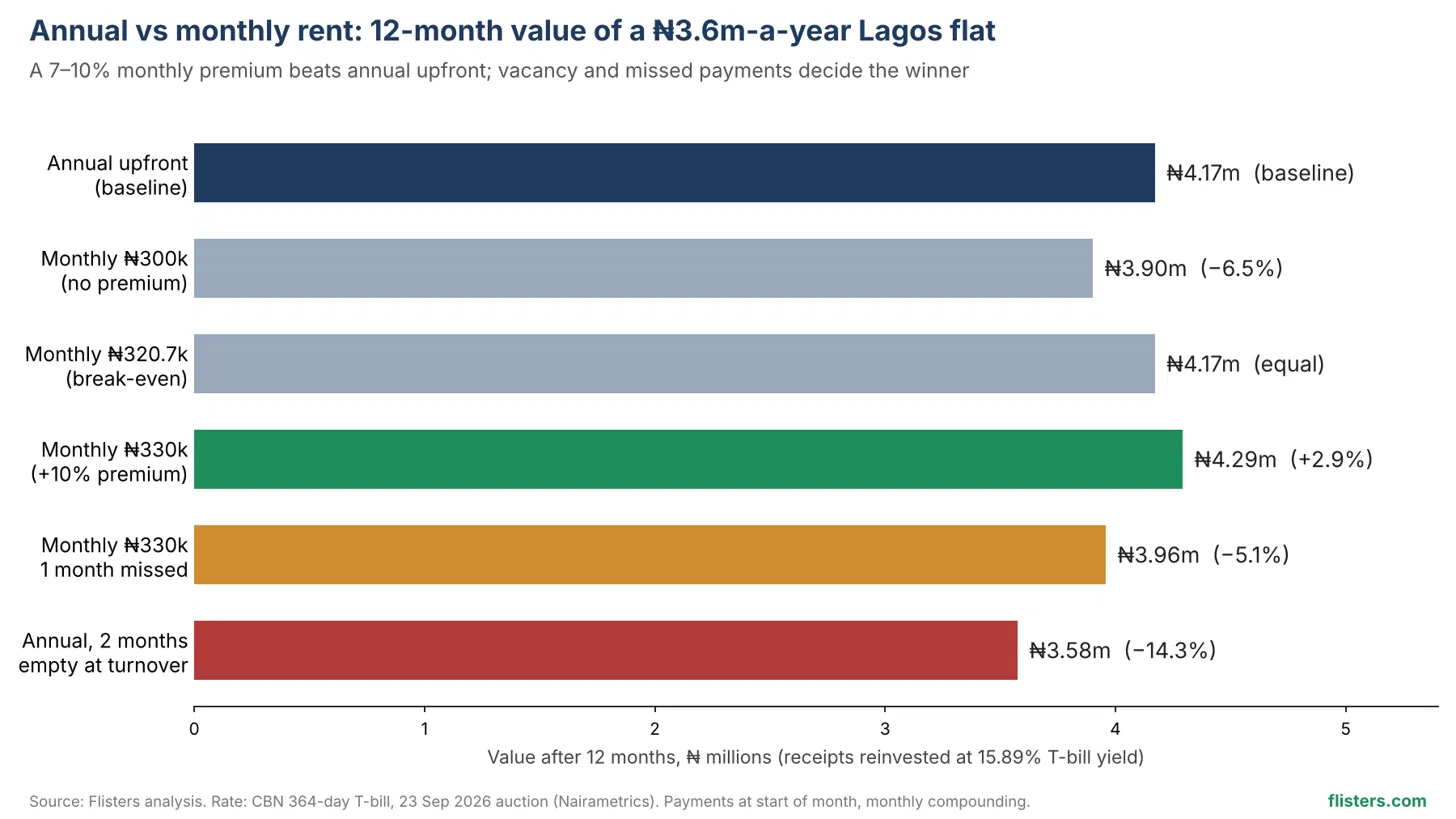
Assumptions: payments at the start of each month, all receipts reinvested at the 15.89% one-year T-bill rate compounded monthly, no agency or legal fees, figures rounded to the nearest ₦1,000. Swap in your own rent and yield; the logic holds.
Pros and cons of annual and monthly rent for landlords
Annual rent buys certainty; monthly rent buys a bigger pool of tenants and a higher total. Here is how they compare on the factors landlords care about most.
Factor | Annual rent | Monthly rent |
|---|---|---|
Cash on day one | Full year in hand | One month in hand |
Investment return on rent | Highest: lump sum can go straight into T-bills | Lower, unless you charge a premium |
Pool of qualified tenants | Small: only people with ₦3m+ in cash | Large: anyone with a steady salary |
Time to fill a vacancy | Often weeks or months | Usually faster |
Default risk | Near zero for 12 months | Present every month |
Admin work | One collection, one receipt | 12 collections, 12 receipts, reminders |
Funding big repairs | Easy: lump sum available | Needs a sinking fund |
Rent reviews | Once a year, six months' notice | Easier to review and adjust |
Tenant relationship | Contact once a year | Regular contact, early warning of problems |
Exit if things go wrong | Slow: yearly tenant needs six months' notice | Faster: monthly tenant needs one month's notice |
The last row surprises many landlords. Under the Lagos Tenancy Law, a monthly tenancy ends with one month's notice, while a yearly tenancy requires six months' notice. Monthly terms carry more default risk, but they also let you part ways with a bad tenant much sooner.
As Pulse Nigeria notes, many traditional landlords still refuse monthly payments because they depend on the lump sum for maintenance and fear slow eviction cases. Both fears are valid, and both can be managed.
Which is better for landlords in 2026: annual or monthly rent?
Neither option is better for everyone. The right choice depends on how many units you own, who your tenants are, and how well you can collect.
Choose annual rent if:
You own one or two units and live far from them, including diaspora landlords managing from abroad.
You have a large repair or loan repayment due early in the year.
Your property is in a high-demand area where tenants with lump sums are still plentiful.
Choose monthly rent if:
You own five or more units, so one late payer does not sink your cash flow.
Your target tenants are salaried professionals: nurses, teachers, bankers, tech workers.
Your flats have remained vacant for more than a month because applicants could not raise the full amount.
You can enforce a firm due date and follow up the same day a payment is missed.
Consider a hybrid if you are unsure. Many landlords now offer quarterly payments, or annual payments for existing tenants and monthly payments for new ones, with a three-month deposit. A common structure is a 5–10% premium on monthly terms, with a discount for tenants who still pay yearly.
Go back to Mrs Adebayo. Her nurse applicant offered ₦310,000 per month for a flat that rents for ₦3.6 million per year. That is below the ₦320,700 break-even on paper. But her flat had been empty for almost three months, costing her ₦900,000 in lost rent. Accepting at ₦310,000 with a firm due date, or countering at ₦325,000, would have left her well ahead.
How to make monthly rent collection work without the headache
Monthly rent succeeds or fails on collection. The landlords who make it work treat rent like a business process, not a favour. Here is the playbook.
Write it into the tenancy agreement. State the monthly amount, the due date (the 1st or the 5th works best around salary days), the grace period, and what happens after a missed payment.
Take a sensible deposit. One to three months' rent as a refundable caution deposit covers you while you follow up on a missed payment.
Price for the extra work. Use the break-even maths above. On most mainland flats, a 7–10% monthly premium compensates you for lost interest and admin.
Send reminders before the due date, not after. A reminder three days before, on the day and the day after removes most "I forgot" excuses.
Issue a receipt for every payment. The Lagos Tenancy Law requires landlords to issue rent receipts, and failure to do so carries a fine. Twelve receipts per tenant a year add up fast.
Keep a clean ledger. If a case ever reaches court, a dated record of every payment and every reminder is your strongest evidence.
Build a repair fund. Set aside a fixed share of each month's rent so a burst pipe does not wait until next January.
Done by hand across six or sixty units, that is a lot of WhatsApp messages, bank-app checks and handwritten receipts. This is exactly the job Flisters was built for. Flisters is an AI-powered property management platform for Nigerian landlords and property managers. It automates rent collection, sends tenants reminders, and keeps your financial records and reports in one place, so collecting monthly feels as light as collecting once a year.
You get the larger tenant pool and the monthly premium, without becoming a full-time debt collector. See Flisters pricing to find a plan that fits your portfolio.
Frequently asked questions
Is monthly rent legal in Nigeria? Yes. Nothing in Nigerian law requires annual rent. The Lagos Tenancy Law 2011 already recognises monthly tenancies and caps advance rent for sitting monthly tenants at six months.
Can a landlord in Lagos demand two years' rent? No, not for most of Lagos. Section 4 of the Lagos Tenancy Law 2011 bans collecting more than one year's rent from a new tenant. Ikoyi, Victoria Island and some other premium areas are excluded.
How much more should landlords charge for monthly rent? About 7–10% more than the annual rent divided by 12. At a 15.89% Treasury bill yield, a ₦3.6 million flat breaks even at roughly ₦320,700 a month.
What happens if a monthly tenant stops paying? The landlord serves the correct notice and recovers the property through court. A monthly tenancy needs one month's notice to end, compared with six months for a yearly tenancy. Self-help evictions are not allowed.
Is the new Lagos tenancy bill law yet? No. The Lagos State Tenancy and Recovery of Premises Bill 2025 was still at committee stage in the Lagos House of Assembly as of September 2026. The 2011 law still applies.
What is the best way to collect monthly rent in Nigeria? Use automated reminders, a fixed due date, digital receipts, and a single ledger for all tenants. Property management software such as Flisters handles all four for you.
Conclusion: The numbers favour landlords who can collect
The annual-upfront model made sense when tenants had savings and inflation was high enough to make every early naira precious. In 2026, inflation is easing, T-bill yields are falling following the CBN rate cut, and the pool of tenants who can pay a year upfront continues to shrink.
That shifts the maths. A modest monthly premium closes the interest gap. Faster letting removes the costly empty months. The only thing left between you and a better return is collection discipline: firm due dates, timely reminders, proper receipts and a clean record.
You do not have to choose between certainty and growth. Price monthly terms properly, protect yourself with a deposit and a clear agreement, and let software do the chasing.
Ready to offer monthly rent without losing sleep? Start with Flisters and automate rent collection, reminders and reporting across every unit you own. For more guides on running a profitable rental business, browse Flisters Insights.


