


Now you are scrolling through WhatsApp, trying to remember which of your eleven tenants actually sent their transfer, which one paid half, and which one sent a screenshot you never confirmed with your bank.
If this sounds familiar, you are not alone. For many Nigerian landlords and property managers, collecting rent feels less like running a business and more like debt recovery. It costs you time, airtime, and goodwill. Worse, it quietly damages the relationship you need to keep good tenants for years.
The good news is that chasing is a symptom, not the disease. Rent chasing happens when there is no system. Put a simple system in place, and most tenants will pay on time without a single phone call.
Quick answer: How do you collect rent without having to chase tenants in Nigeria? Set one fixed due date in a written tenancy agreement, send automatic reminders 7, 3, and 1 day before that date, allow tenants to pay online by card or bank transfer, issue an instant receipt for every payment, and follow a written, lawful escalation plan for late payers. Automation handles the reminders and record-keeping, so you only step in for the rare tenant who still does not pay.
In this guide, we break that answer down step by step, explain why phone calls are the least effective tool you have, and show you how to stay on the right side of Nigerian tenancy law when a tenant falls behind.
Why Rent Chasing Is So Common in Nigeria

Before fixing the problem, it helps to understand why it keeps happening. Talk to landlords in Lagos, Abuja, Ibadan, or Port Harcourt, and the same five causes come up again and again.
1. The due date lives in the landlord's head.
Many tenancies, especially those agreed through an agent or a family contact, never put a clear due date in writing. The tenant remembers "sometime in January." The landlord remembers "January 1st." That gap alone produces weeks of back-and-forth.
2. Reminders depend on the landlord's mood and memory.
When reminders are manual, they arrive inconsistently. One month you call a week early. The next month you forget until the 10th. Tenants quickly learn that the real deadline is "whenever the landlord calls."
3. Payment is inconvenient.
Some landlords still prefer cash or ask tenants to pay into a personal account and then "send proof." Every extra step gives a struggling tenant a reason to delay.
4. Records are scattered.
Transfers land in your bank app. Screenshots land in WhatsApp. Cash lands in an exercise book. When a tenant says "I paid," you cannot confirm quickly, so you hesitate to follow up firmly.
5. The relationship feels personal.
Most Nigerian landlords know their tenants personally or through someone. Calling to ask for money feels awkward, so you delay. Then you get frustrated. By the time you finally call, the conversation is already tense.
Notice that none of these causes is "bad tenants." Some tenants will always struggle. But most late rent in Nigeria is caused by unclear expectations and inconvenient processes, both of which are fixable.
A 6-Step System to Collect Rent Without Chasing Tenants
This is the system professional property managers use. You can run it manually at first, but it works best when software handles the repetitive parts.
Step 1: Put one clear due date in writing.
Every tenancy should have a written agreement that specifies the rent amount, the payment frequency (monthly, quarterly, or yearly), the exact due date, accepted payment methods, and the consequences of late payment.
If you collect yearly rent, still state the renewal date clearly. For example: "Rent for the next tenancy year is due on or before 1st March each year." Ambiguity is the enemy of on-time rent.
In Lagos, the Tenancy Law also caps the amount of advance rent. Landlords may not demand more than one year's rent in advance from a new tenant or more than six months' rent from a sitting tenant. Set your due dates based on what the law allows in your state.
Step 2: Set a grace period, and stick to it.
A grace period is the short window after the due date when payment is still accepted without penalty. Three to five days is common. The point is not to be lenient. The point is to make the rule predictable. Once tenants know the grace period ends on the 5th, the 5th becomes the real deadline, and they respect it.
Step 3: Send reminders before rent is due, not after.
This is the single biggest change most landlords can make. Chasing happens after the due date. Reminders happen before it.
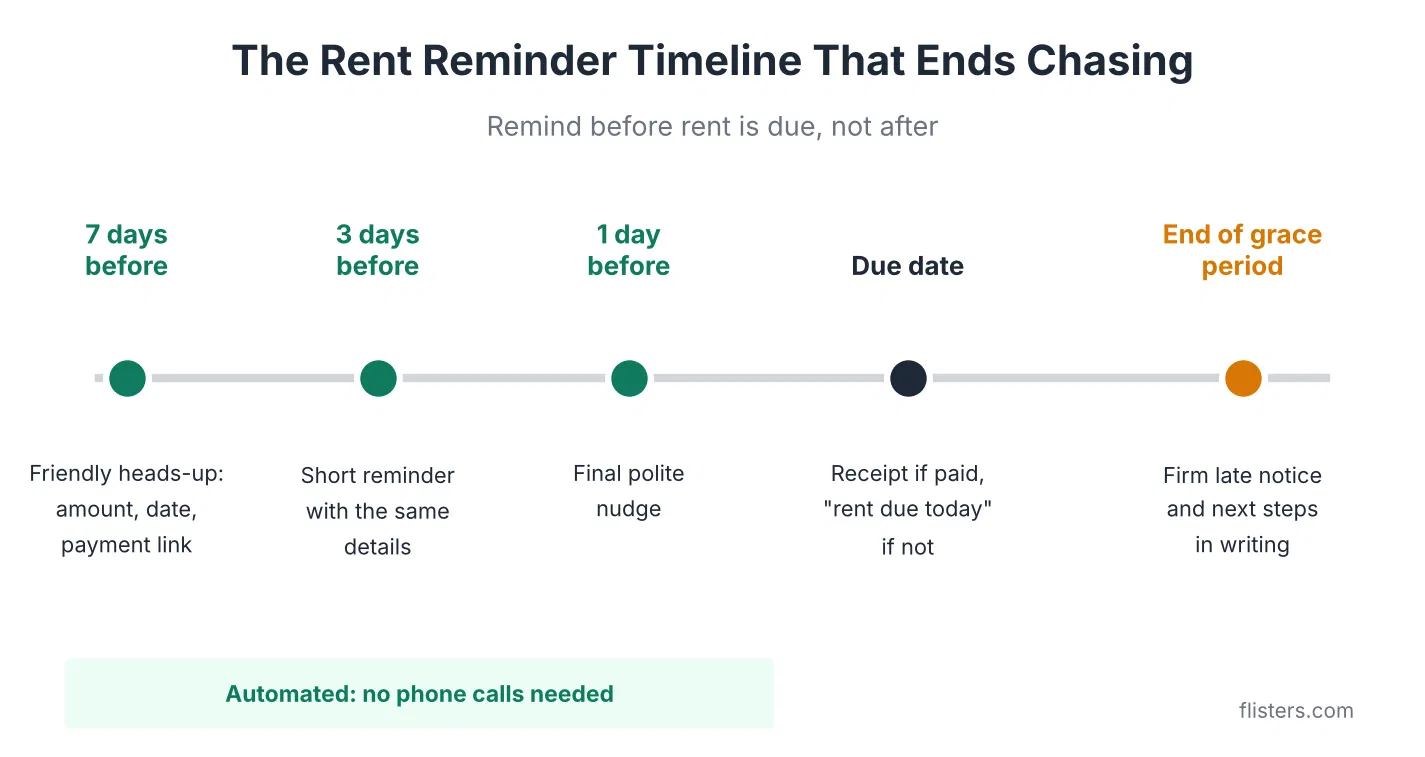
A proven reminder schedule looks like this:
7 days before: a friendly heads-up with the amount, due date, and payment link.
3 days before: a short reminder with the same details.
1 day before: a final, polite nudge.
Due date: a confirmation if paid, or a "rent is due today" note if not.
End of grace period: a firmer message stating that the payment is now late and what happens next.
Reminders work because most late payers are not refusing to pay. They are busy or juggling other bills. A reminder at the right time moves your rent to the top of their list.
Step 4: Make paying easy
Every barrier between the tenant and the payment costs you days. Offer card payments and bank transfers, and give each tenant a clear way to pay that automatically links the payment to their unit.
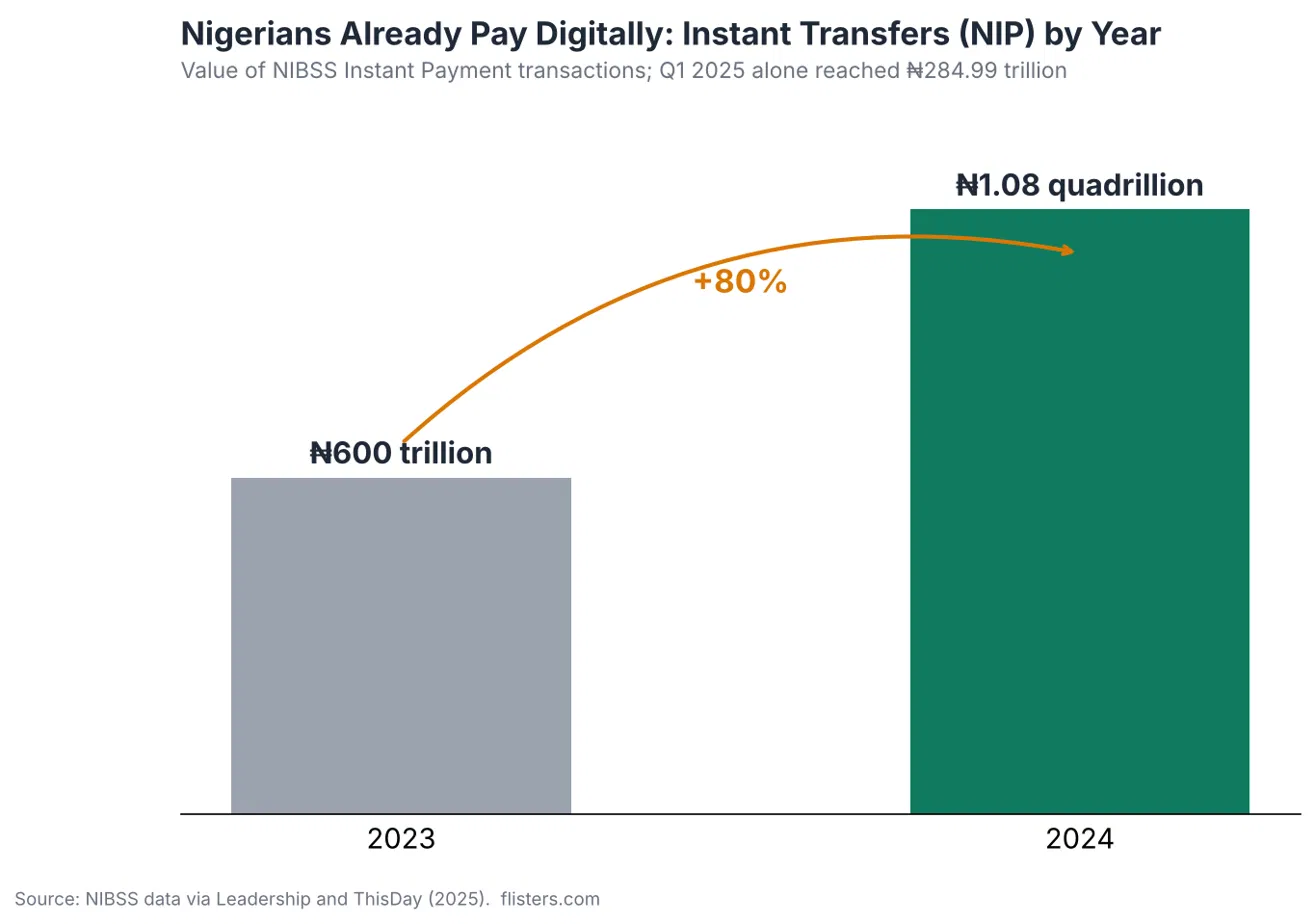
Nigerians are already comfortable paying digitally. According to NIBSS figures reported by ThisDay, electronic payment transactions reached N284.99 trillion in Q1 2025, up 17.7% year-on-year. And instant transfers for all of 2024 crossed N1 quadrillion, compared with about N600 trillion in 2023. Your tenants already pay school fees, DSTV, and electricity this way. Rent should be no different.
Step 5: Issue a receipt for every payment instantly.
A receipt protects both sides. It confirms the amount, the period covered, and the date paid. In Lagos, issuing a rent receipt is a legal expectation, and it becomes critical evidence if a dispute ever reaches the Rent Tribunal.
Instant digital receipts also end the "I paid, check your account" conversation. If there is no receipt, there was no confirmed payment.
Step 6: Write down your escalation plan.
Decide in advance what you will do when a tenant is late, and apply it consistently to everyone. A simple ladder:
Automated late notice at the end of the grace period.
A personal message or call from you or your property manager, now with full records in hand.
A written demand letter.
Formal legal steps, only through the proper process (covered below).
When the plan is written and consistent, follow-up stops feeling personal. You are not "disturbing" the tenant. You are following the process you both agreed to.

Why Automation Beats Phone Calls
Phone calls feel personal and direct. That is exactly the problem. Here is how manual calling compares with automated reminders and online collection.
What matters
Phone calls and WhatsApp follow-ups
Automated reminders and online collection
Timing
Whenever you remember
Same schedule, every month, for every tenant
Tone
Depends on your mood that day
Consistent and professional
Records
Scattered across call logs, chats, and bank alerts
One payment history per tenant and unit
Proof of payment
Screenshots you must verify
Instant confirmation and automatic receipt
Your time
Hours each month, growing with every unit
Minutes to review a dashboard
Tenant relationship
Can feel like harassment
Feels like a normal service notification
Legal evidence
Hard to prove what was said
Dated, written record of every reminder
1. Consistency changes tenant behaviour.
People pay the bills that reliably remind them. Your electricity token, your phone subscription, and your children's school fees all arrive with predictable notices. When rent reminders become just as predictable, rent moves into the same "must pay" category.
2. Automation removes the awkwardness
An automated reminder is not you asking for money. It is the system doing its job. This protects your relationship with good tenants, and it frees you to save personal calls for the few situations that truly need them.
3. It scales with your portfolio.
Calling three tenants is manageable. Calling thirty is a part-time job. If you manage properties for other landlords, manual chasing caps the number of units you can take on. Automation lets you grow without hiring someone just to make calls.
4. It creates a paper trail.
If a dispute ever escalates, a dated record of written reminders, notices, and receipts is far stronger than "I called him many times." Courts and tribunals in Nigeria rely on documents, not memory.
5. It tells you who needs attention.
Good rent collection software shows at a glance who has paid, who paid partially, and who has not paid at all. Instead of calling everyone, you focus on the one or two tenants who actually need a conversation.
What to Do When a Tenant Still Doesn't Pay: Stay Within the Law
A good system will reduce late payments dramatically, but it will not eliminate them. When a tenant falls seriously behind, how you respond matters as much as what you do.
Never use self-help. Changing the locks, removing the roof, cutting off the water, or throwing out a tenant's property is illegal. Under Nigerian law, a landlord cannot evict a tenant without first serving a proper Notice to Quit. The Lagos Tenancy Law specifically outlaws self-help evictions.
Know your notice periods. Under Section 13 of the Lagos State Tenancy Law 2011, where the agreement is silent, the minimum notice is one week for a tenant at will, one month for a monthly tenant, three months for a quarterly tenant and six months for a yearly tenant. Other states follow similar principles, but the details differ, so check the law in your state.
Fixed-term tenancies work differently. When a fixed-term tenancy has ended, no notice to quit is required, and the landlord serves a seven-day notice of intention to recover possession instead.
Keep your documents ready. If the matter goes to court or the Rent Tribunal, you will need the tenancy agreement, rent receipts, records of reminders and demands, and proof that notices were properly served. This is where an automated system pays for itself: the evidence is already organised.
Get professional advice. Notices must follow prescribed forms and be served correctly. A small mistake can restart the clock. Speak with a qualified lawyer before taking formal steps.
This section is general information, not legal advice.
How Flisters Automates Rent Collection for Nigerian Landlords
Flisters was built for exactly this problem. Instead of a notebook, a bank app and a WhatsApp thread, you get one system that runs the six steps above for you.
AI-powered rent reminders. Flisters sends automated reminder sequences at 7, 3 and 1 day before rent is due, by email. Messages can be written in English or Pidgin, and their urgency is adjusted based on each tenant's payment history. SMS and WhatsApp reminders are on the roadmap.
Online rent collection. Tenants pay by card or bank transfer, 24/7. You get instant confirmation, and partial payments are tracked properly instead of getting lost.
Automatic receipts. Every payment generates a digital receipt and sends it to the tenant. No more "please send proof."
Tenant portal. Tenants can check their rent status, see their payment history and download receipts on their own.
Landlord dashboard and reports. See who has paid, who hasn't and how much has been collected. Export landlord-ready reports to PDF or Excel in one click, which is ideal if you manage property on behalf of owners.
The result is simple: reminders go out on time, payments land with a receipt, and you only pick up the phone when it genuinely matters.
If you are just starting out, our guide to the real estate business in Nigeria covers the bigger picture, and you can browse more landlord guides on the Flisters Insights page.
Ready to stop chasing rent? Create your free Flisters account and set up your first property in minutes, or compare plans on our pricing page.
Conclusion
Chasing rent is not a personality problem or a tenant problem. It is a systems problem. Write down one clear due date, set a grace period, remind tenants before rent is due, make payment easy, provide a receipt for every naira, and follow a lawful escalation plan.
Do these things consistently and most of your tenants will pay without a call. Automate them, and you get your time back to focus on growing your portfolio instead of managing excuses.
Frequently Asked Questions
How do I remind my tenant to pay rent politely?
Send a short, friendly written reminder a week before the due date that states the amount, the due date and how to pay. Follow it with shorter reminders three days and one day before. Written reminders feel less confrontational than calls and create a record.
When should I send a rent reminder?
The most effective schedule is 7 days, 3 days, and 1 day before rent is due, with a final notice when the grace period ends. Reminding tenants before the due date prevents most late payments.
Can a landlord in Nigeria lock out a tenant for not paying rent?
No. Self-help eviction, including changing locks or removing a tenant's property, is illegal. A landlord must serve the correct notices and recover possession through the court or Rent Tribunal.
How much notice must a landlord give a yearly tenant in Lagos?
Where the tenancy agreement does not say otherwise, the Lagos State Tenancy Law 2011 requires six months' notice for a yearly tenant. Once a fixed-term tenancy has expired, a seven-day notice of intention to recover possession applies instead.
What is the best way to collect rent in Nigeria?
The best way is online collection by card or bank transfer, linked to automated reminders and instant receipts. It is faster for tenants, easier to track for landlords and creates clear records for both sides.
Is rent collection software worth it for a small landlord?
Yes, even with a handful of units. Automated reminders, receipts and payment tracking save hours every month and reduce late payments. Most platforms, including Flisters, let you start for free.


