


Why your late rent policy matters more than your rent amount
Then the tenant who was pushed on day two compared notes with the tenant who got four months. Within a month, half the compound was paying late, and everyone had a reason why the rule didn't apply to them.
The problem was never his tenants. It was that he had no written, predictable rule. A late rent policy only works when tenants know it before they sign, see it again before rent is due, and watch it applied the same way to everyone.
Quick answer: what is a fair late rent policy in Nigeria? A fair late rent payment policy in Nigeria sets a written grace period (usually 5 to 7 days for monthly rent, 14 to 30 days for annual rent), a modest capped late fee that reflects your real cost of the delay, and a clear timeline from reminder to formal demand to notice to quit. It must be written into the tenancy agreement, shared before the due date, and applied consistently to every tenant.
This guide shows you how to build that policy: how long the grace period should be, which penalties Nigerian courts are likely to uphold, and the exact wording to use so tenants feel treated fairly, not threatened.
Why most late rent policies fail in Nigeria
Most Nigerian landlords don't have a late rent policy. They have a mood. Here are the four patterns that worsen late payments.
The rule lives in the landlord's head. If it isn't in the tenancy agreement, tenants can honestly say they never agreed to it, and a court has nothing to enforce.
The penalty is too harsh to use. A clause that says "₦50,000 per day late" sounds powerful. In practice, landlords are embarrassed to apply it, tenants dispute it, and a court is likely to strike it down as a penalty. A rule you never use teaches tenants that rules don't matter.
Exceptions are made in private. One tenant's extension becomes everyone's precedent the moment it is discussed on the compound WhatsApp group.
The first contact is a threat. Many landlords stay silent until rent is weeks overdue, then open with "pack out." The tenant becomes defensive, and a payment problem turns into a dispute.
Pressure on tenants makes this worse. Headline inflation was still 15.91% in June 2026, according to the National Bureau of Statistics, and food inflation was higher still. Many good tenants pay late not because they don't respect you, but because salaries arrive late and prices keep changing. A good policy separates those tenants from chronic defaulters early.

What Nigerian law says about late fees and rent arrears
No Nigerian statute sets a standard late rent fee. Late fees are a matter of contract, so they live or die by your tenancy agreement and by the general law on penalty clauses. Here is what shapes your policy.
1. The tenancy agreement is your rulebook
In Lagos, the Lagos State Tenancy Law 2011 governs most residential and commercial tenancies. Many of its rules apply "subject to" what the parties agreed, which is why a clear written agreement matters so much. A grace period or late fee that isn't in the agreement is very hard to enforce.
2. Courts uphold compensation, not punishment
Nigerian courts follow the common-law distinction between liquidated damages and penalties. As BusinessDay explains, an agreed sum is enforceable when it is a genuine pre-estimate of the loss a breach causes, but a figure set to frighten or punish the other party is likely to be struck down. Calling it a "late fee" instead of a "penalty" doesn't change the test.
For landlords, the practical lesson is simple: tie your late fee to real costs. Those costs include the time spent chasing payment, bank or transfer fees, and the cost of covering your own obligations (service charges, loan repayments, maintenance) while rent is outstanding.
3. Receipts and records protect you
The Lagos law requires landlords to issue a rent receipt showing the date, the amount and the period covered, and failing to do so is an offence. A receipt for every payment, including late fees and part payments, is also your best evidence if a dispute ever reaches the Rent Tribunal or court.
4. Late rent never justifies self-help
However late the rent is, you cannot lock a tenant out, remove the roof, cut off the water, or throw out their belongings. LawPadi notes that no Lagos landlord may personally evict a tenant, whatever the arrears. Recovery proceeds through demand notices, a valid notice to quit, a 7-day notice of the owner's intention to recover possession, and then the court or tribunal.
5. Notice periods follow the type of tenancy
If your agreement is silent, Section 13 of the Lagos law sets the minimum notice to quit:
Type of tenancy | Minimum notice to quit (Lagos, if agreement is silent) |
|---|---|
Tenancy at will / weekly | 1 week |
Monthly | 1 month |
Quarterly | 3 months |
Half-yearly | 3 months |
Yearly | 6 months |
Source: Lagos State Tenancy Law 2011, s.13, as summarised by Street Lawyer Naija.
Outside Lagos? Many states still rely on the Recovery of Premises Act or their own rent control laws, and some areas in Lagos (such as Apapa, Ikeja GRA, Ikoyi, and Victoria Island) are excluded from the 2011 Law. Lagos also has a 2025 Tenancy and Recovery of Premises Bill in progress; check whether it has become law before relying on current notice periods. When in doubt, have a property lawyer review your clause once, then reuse it.
This article is general information, not legal advice.
How long should a grace period for rent be in Nigeria?
A grace period is the window after the due date when rent is technically late, but no fee applies. It is the single most effective tool for keeping good tenants on side, because it absorbs the ordinary delays of Nigerian life: salaries paid on the 28th instead of the 25th, a failed transfer, a bank app that won't open.
The right length depends on how often rent is paid.
Rent frequency | Recommended grace period | Why |
|---|---|---|
Monthly | 5 to 7 days | Covers late salary payment and transfer failures without letting arrears pile up |
Quarterly | 7 to 14 days | Larger sum; tenants may be gathering it from more than one source |
Annual / renewal | 14 to 30 days | Big lump sum; agree a renewal reminder 60 to 90 days ahead so the grace period is rarely needed |
Commercial (shops, offices) | 7 to 14 days | Business cash flow varies; tie it to the trading cycle |
Grace period rules that keep it fair
Write the exact number of days. "A reasonable time" invites argument. "Seven (7) calendar days after the due date" does not.
Say what happens on the last day. If day 7 falls on a Sunday or public holiday, does it roll to Monday? Decide now.
Make it the same for everyone. If you want to reward long-standing tenants, do it openly: for example, add an extra 3 days after 12 months of on-time payments, written into the renewal.
Don't extend it silently. Every unofficial extension resets tenants' belief about the real deadline.
A grace period is not a payment plan. If a tenant needs more than the grace period, that requires a separate written arrangement, as outlined below.
Late rent penalties that tenants accept and courts uphold
The best late fee is small enough that you will actually charge it every time, and large enough that paying on time is clearly cheaper. There are three common structures.
Structure | How it works | Best for | Watch out for |
|---|---|---|---|
Flat fee | One fixed charge once the grace period ends | Monthly rent, simple portfolios | Must still bear some relation to your real cost |
Percentage | A set percentage of the overdue amount, charged once | Mixed rent levels across units | High percentages on annual rent become huge sums |
Capped daily or monthly charge | A small charge for each day or month the rent stays unpaid, up to a stated maximum | Long arrears, commercial lets | Without a cap, it can look punitive |
Worked example: a ₦250,000 monthly flat in Yaba
Rent is due on the 1st, with a 7-day grace period.
Flat fee option: ₦10,000 if unpaid by the end of the 8th. That is 4% of the month's rent, roughly what it costs you in time, calls and transport to chase one payment.
Percentage option: 5% of the overdue amount (₦12,500), charged once.
Capped daily option: ₦1,000 per day from day 8, capped at ₦25,000 (10% of the month's rent).
All three are defensible because they are modest, stated in advance, and capped. Compare that with "₦20,000 per day until paid," which would total ₦600,000 in a month, more than double the rent. That is the kind of clause a court is likely to treat as a penalty.
Worked example: a ₦3,000,000 annual renewal in Lekki
A 5% fee on annual rent is ₦150,000, which tenants will resent and you may struggle to justify. For annual rent, a better structure is:
a 21-day grace period after the renewal date, then
a flat administrative fee (for example, ₦30,000), plus
interest on the unpaid balance at a stated monthly rate (for example, 2% per month), capped at a stated total.
The interest reflects the real cost of your money being tied up while inflation remains in the mid-teens.
Five rules for any late fee clause
State it as compensation. Describe the fee as covering administrative costs and loss of use of funds, not as a "fine."
Cap it. A clear maximum, such as 10% of one month's rent, shows the clause is not designed to punish.
Never compound it. Don't charge late fees on late fees.
Issue a receipt for it. A fee you collect without a receipt is a fee you can't prove.
Allow a waiver, in writing. You may choose to waive a fee for a genuine emergency, but record the waiver so it doesn't become the new rule.
How to communicate your late rent policy fairly
Tenants rarely object to a rule they saw coming. They object to surprises. Fair communication happens at four moments.
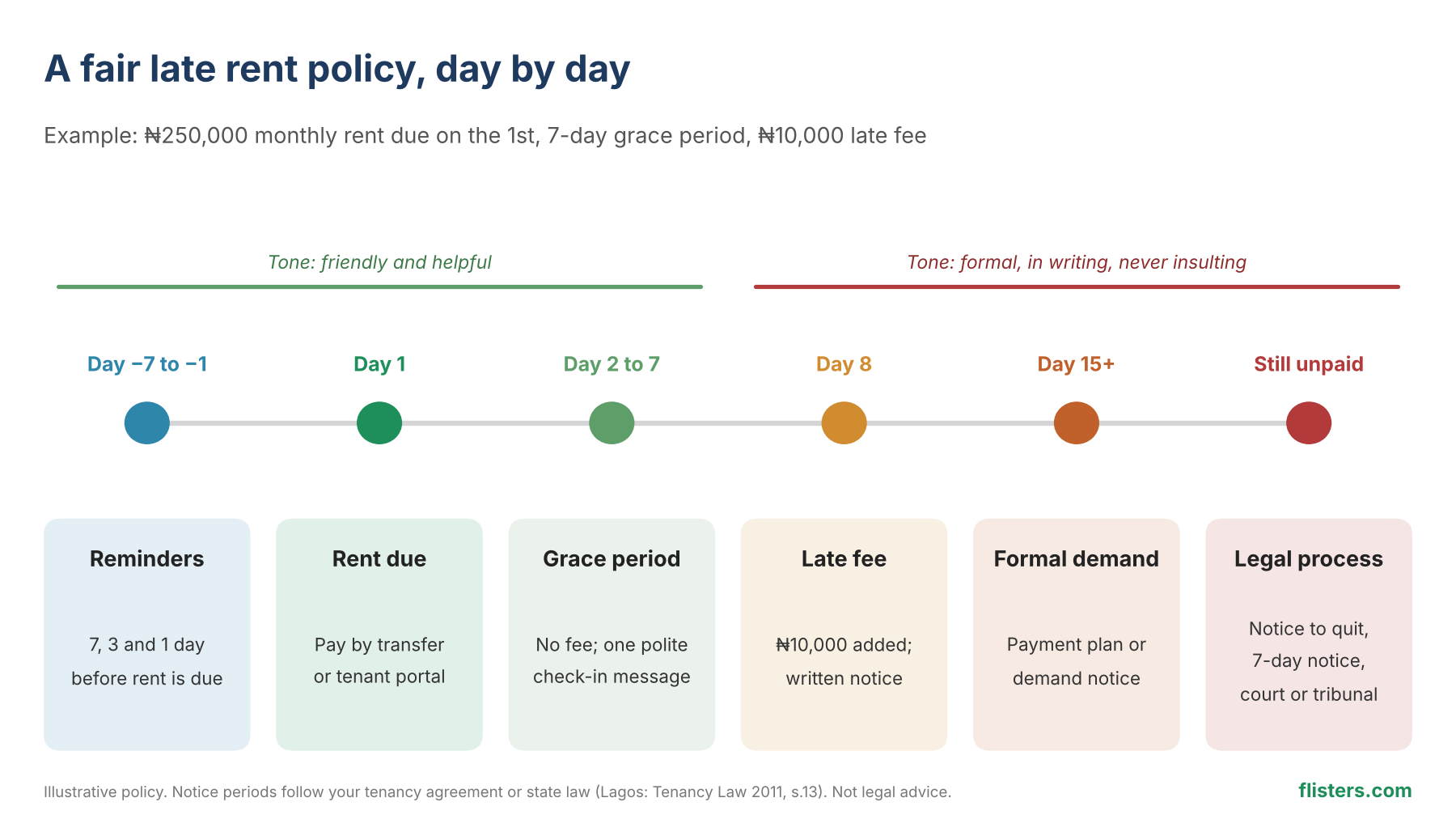
Moment 1: Before the tenancy agreement is signed
Walk the tenant through the rent clause in person or on a call. Point to the due date, the grace period and the late fee, and ask them to initial that page. This takes five minutes and prevents months of argument. If the tenant pushes back, negotiate now, not after the first missed payment.
Moment 2: Before rent is due
A reminder before the due date is not nagging; it is service. Send reminders 7, 3 and 1 day before rent is due for monthly tenants, and 90, 30 and 7 days before renewal for annual tenants. Keep the tone friendly:
Good morning Mrs. Bello, a quick reminder that your rent of ₦250,000 for Flat 3 is due on 1 November. You can pay by transfer or through your tenant portal. Thank you for always being prompt.
Moment 3: During the grace period
One short, warm message on the day after the due date catches honest mistakes:
Hi Mrs. Bello, we haven't received November's rent yet. No problem if it's on the way; just a reminder that the grace period ends on 8 November, after which the ₦10,000 late fee in your agreement applies. Let me know if anything is holding it up.
That last sentence matters. It invites the tenant to tell you about a problem before it becomes arrears.
Moment 4: After the grace period ends
Now the tone becomes formal, but never insulting. State the facts, the amount and the next step in writing:
Dear Mrs. Bello, November rent of ₦250,000 remains unpaid after the grace period. In line with clause 4 of your tenancy agreement, a late fee of ₦10,000 has been added, bringing the balance to ₦260,000. Please pay by 15 November or contact me to agree a written payment plan. If neither happens, I will issue a formal demand notice.
If there is still no payment, move to a formal written demand and, if necessary, the legal process. Our guide on what to do when a tenant owes rent walks through each stage.
When a tenant asks for more time: payment plans
A written payment plan is often better than a notice to quit. Eviction in Nigeria can take months, and an empty flat earns nothing. A good plan:
states the total owed, including any late fee;
splits it into dated instalments (for example, ₦130,000 on the 15th and ₦130,000 on the 30th);
says that the late fee is waived or reduced if every instalment is paid on time;
says what happens if an instalment is missed; and
is signed or acknowledged in writing by both sides.
Offer plans to every tenant under the same rules: for example, one plan per 12 months, and never for more than two months' rent.
Sample late rent clause for a Nigerian tenancy agreement
Adapt this to your property and have a lawyer review it once before you reuse it across your portfolio.
Clause 4: Rent payment, grace period and late charges
4.1 The Tenant shall pay rent of ₦[amount] [monthly/yearly] in advance on or before the [1st] day of each [month/renewal date] ("the Due Date").
4.2 Rent received within [seven (7)] calendar days after the Due Date ("the Grace Period") shall attract no late charge. Where the last day of the Grace Period falls on a Sunday or public holiday, it shall end on the next working day.
4.3 Where rent remains unpaid after the Grace Period, the Tenant shall pay a late charge of ₦[amount], which the parties agree is a genuine pre-estimate of the Landlord's administrative costs and loss of use of funds, and not a penalty. Total late charges for any single rent period shall not exceed [10%] of that period's rent.
4.4 The Landlord shall issue a written receipt for every payment, including any late charge or part payment.
4.5 Any extension of time or payment plan shall be valid only if agreed in writing, and shall not waive the Landlord's rights for any other rent period.
4.6 Nothing in this clause limits the Landlord's right to recover arrears or possession in accordance with the applicable tenancy law.
Clause 4.5 is the one most landlords forget. Without it, one kind gesture can later be argued to be a permanent change to the terms.
Consistency is the policy
A perfectly drafted clause fails if you apply it on some days and not others. Tenants talk, and they compare. The landlords whose policies actually work share three habits:
They log everything. Every reminder, every payment, every waiver and every plan, with dates. If you ever need the Rent Tribunal, this record is your case.
They separate the person from the process. "The system has added the late fee" lands better than "I am fining you." It also frees you to be warm in conversation while the rule does the firm work.
They review the policy once a year. Look at who paid late, how often, and why. If half your tenants are paid on the 28th, moving the due date to the 5th may solve more than any fee.
How Flisters makes a fair policy automatic
This is where most landlords and property managers struggle: not with writing the policy, but with running it across 10, 50 or 200 units without forgetting anyone. Flisters was built for exactly this:
Automated reminders are sent 7, 3, and 1 days before rent is due via email, with messages in English or Pidgin and urgency levels that adjust to each tenant's payment history. (SMS and WhatsApp are planned.)
Online rent collection by card or bank transfer, with instant confirmation and automatic digital receipts, so every payment, including part payments, is recorded.
A tenant portal where tenants can see their rent status, payment history and lease documents, so nobody can say they didn't know.
Financial reports and a landlord dashboard that show who is paying late and how often, so your annual review takes minutes.
The result is a policy that is applied the same way to every tenant, every month, without you having to be the bad guy. You can start free or see pricing. For the full collection workflow, read our guide to rent collection for Nigerian landlords, and if you're weighing payment frequency, see our guide to annual vs monthly rent in Nigeria.
Frequently asked questions
Can a landlord charge a late fee for rent in Nigeria?
Yes, if the late fee is written into the tenancy agreement and is reasonable. No Nigerian law sets a standard late fee, so it is a matter of contract. Courts are likely to enforce a modest fee that reflects the landlord's real costs, but may strike down an excessive one as a penalty.
What is a reasonable late fee for rent in Nigeria?
For monthly rent, a flat fee of around 3% to 5% of the month's rent, or a small daily charge capped at about 10% of one month's rent, is generally seen as reasonable. For annual rent, a flat administrative fee plus capped interest on the unpaid balance is fairer than a percentage of the whole year.
How many days is a grace period for rent?
Most Nigerian landlords allow 5 to 7 days for monthly rent and 14 to 30 days for annual rent. The exact number should be stated in the tenancy agreement and applied to all tenants.
Can a landlord evict a tenant for paying rent late in Nigeria?
Not directly or by force. Persistent arrears can be grounds for ending the tenancy, but the landlord must serve a valid notice to quit, then a 7-day notice of the owner's intention to recover possession, and then apply to court or the Rent Tribunal. Locking out a tenant or removing their belongings is unlawful.
Is a landlord allowed to increase rent because a tenant paid late?
A late payment is not a lawful basis for raising rent mid-tenancy. Rent increases should follow the tenancy agreement and applicable law; in Lagos, an unreasonable increase can be challenged in court.
How should I politely remind a tenant to pay rent?
Send a short, friendly reminder before the due date that states the amount, the due date and how to pay. After the due date, send a polite note mentioning the grace period and inviting the tenant to let you know about any issues. Keep every message in writing.
Fair, firm and written down
Go back to Chief Okonkwo. What fixed his compound wasn't a bigger penalty. It was a one-page clause every tenant initialled, a reminder before every due date, a seven-day grace period with no exceptions made in private, and a ₦10,000 late fee he actually charged.
Within six months, late payments had become the exception again. More importantly, the tenants who did struggle came to him early, because they knew exactly what would happen and trusted that it would be the same for everyone.
That is what a late rent payment policy that works looks like in Nigeria: written before signing, communicated before the due date, modest enough to enforce, and applied consistently every time.
Ready to put your policy on autopilot? Create your free Flisters account and set up automated rent reminders, online collection and digital receipts for your properties today.


